PaceAllow an hour or more for a full ceremony. A trip to the Kaffa forests needs several days on the road from Addis Ababa. Other plates in this section.
Ethiopia is the home of Arabica coffee. The plant still grows wild in the montane forests of the south-west, and coffee is woven through daily life everywhere else: grown on smallholdings, traded in markets and served at home in a ceremony that can take an hour or more. The word for it is bunna. If you spend any time in the country you will be offered it, and accepting is one of the easiest ways to understand how hospitality works here.
Where coffee comes from
The best-known origin story tells of a goatherd named Kaldi who noticed his goats becoming lively after eating red berries from a shrub, and who brought the berries to a monastery. It is a legend, told and retold in many versions, but it points to a real place: the forests of south-western Ethiopia, where Coffea arabica grows wild in the shade of taller trees. Many people link the name of the region of Kaffa with the word coffee, though the history of the word is debated.
From these forests coffee spread to Yemen and then to the wider world. In Ethiopia itself, coffee has been drunk, chewed and cooked in different forms for a very long time, and the ceremony you meet today has deep roots.
Kaffa's forests
The Kafa Biosphere Reserve, recognised by UNESCO in 2010, protects areas of montane forest around Bonga where wild coffee grows. Walking in these forests, you see coffee shrubs scattered through the undergrowth beneath tall trees, rather than the neat rows of a plantation. Local people collect wild and semi-wild forest coffee, and the genetic variety of these plants is of great value to growers worldwide.
Reaching Kaffa takes time: it is a long road trip from Addis Ababa, usually via Jimma, through green, rainy country. It suits travellers with a real interest in coffee, forest and birds rather than those on a tight schedule. Visits to forest areas are best arranged locally, with a guide who knows the paths and the communities.
Sidama, Yirgacheffe and Harar
Most Ethiopian coffee comes from smallholders in the southern and western highlands. Sidama and the Yirgacheffe area in Gedeo are known for washed coffees with bright, floral flavours, and their hillsides are planted with coffee under shade trees beside enset and other crops. In the east, the hills around the walled city of Harar produce sun-dried coffee with a heavier, fruity character.
During the harvest, roughly from October into the early months of the year, you will see ripe red cherries picked by hand, collection points busy with sacks, and beans spread on raised beds to dry. The southern coffee country lies within reach of the Rift Valley lakes, so a detour into the coffee hills can be added to a southern trip.
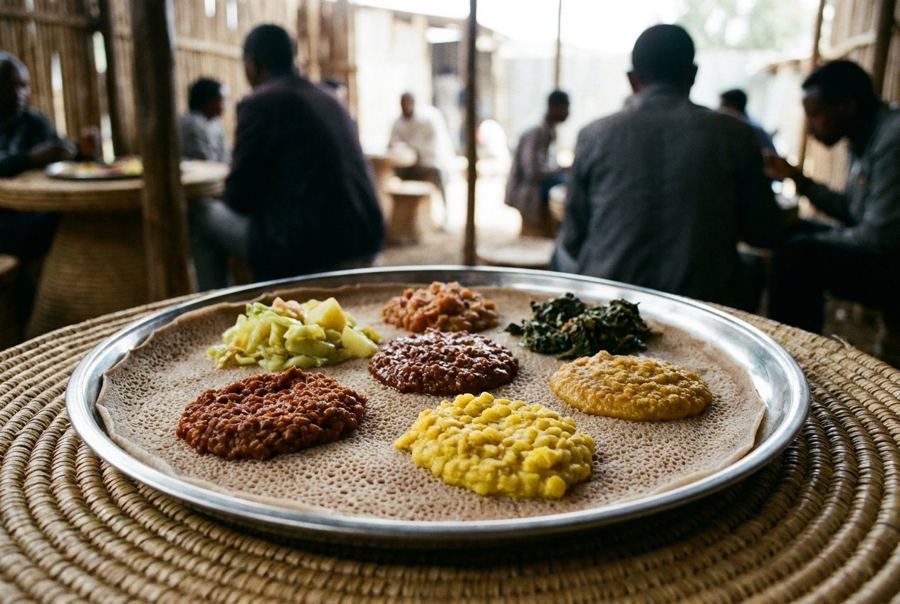 Plate 17 · EthiopiaInjera and the fasting table
The ceremony step by step
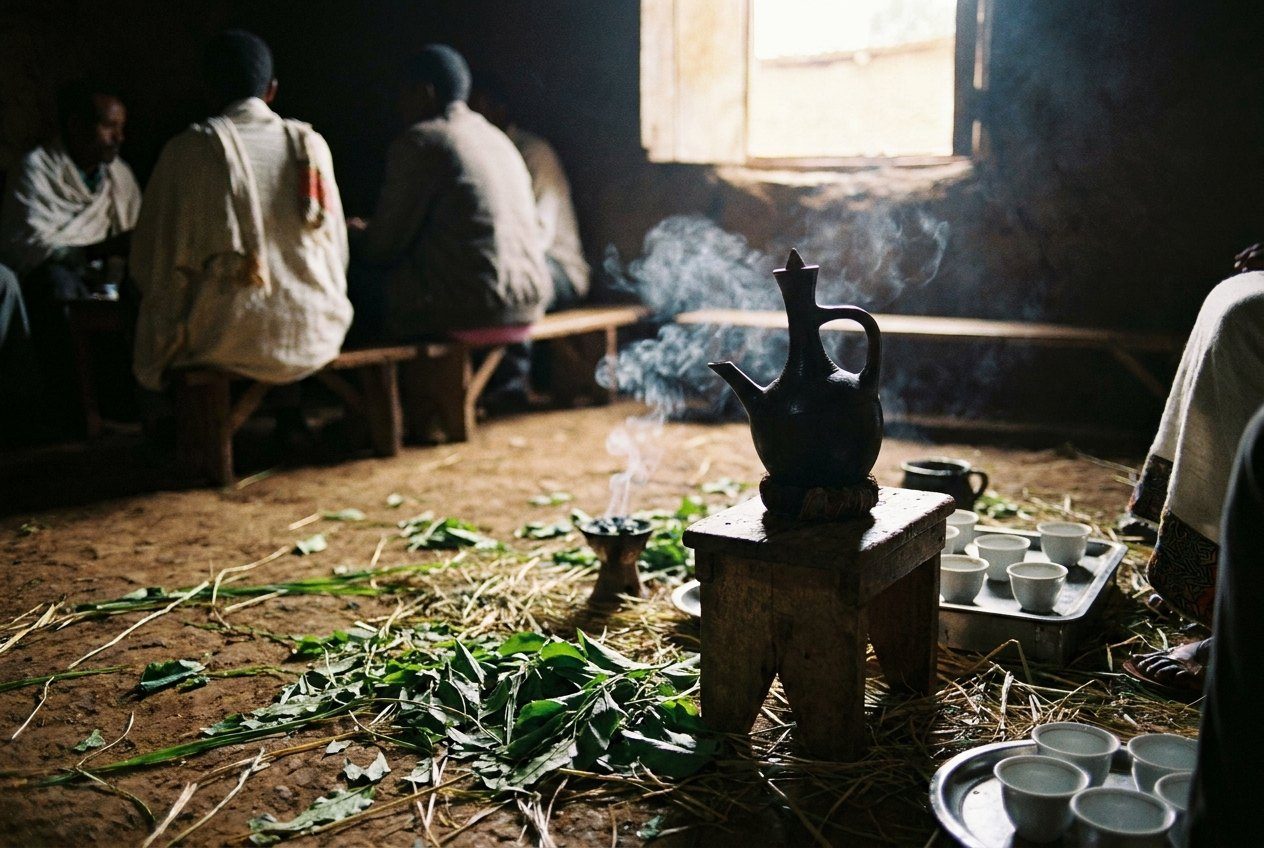
A coffee ceremony is usually prepared by a woman of the household, and it unfolds slowly. Fresh grass or leaves may be scattered on the floor, and frankincense burns on charcoal nearby. The green beans are washed and then roasted in a flat pan over the coals, stirred until they darken and crackle. The pan of smoking beans is carried round so that everyone can breathe in the aroma; waving the smoke towards you is a polite way to show appreciation.
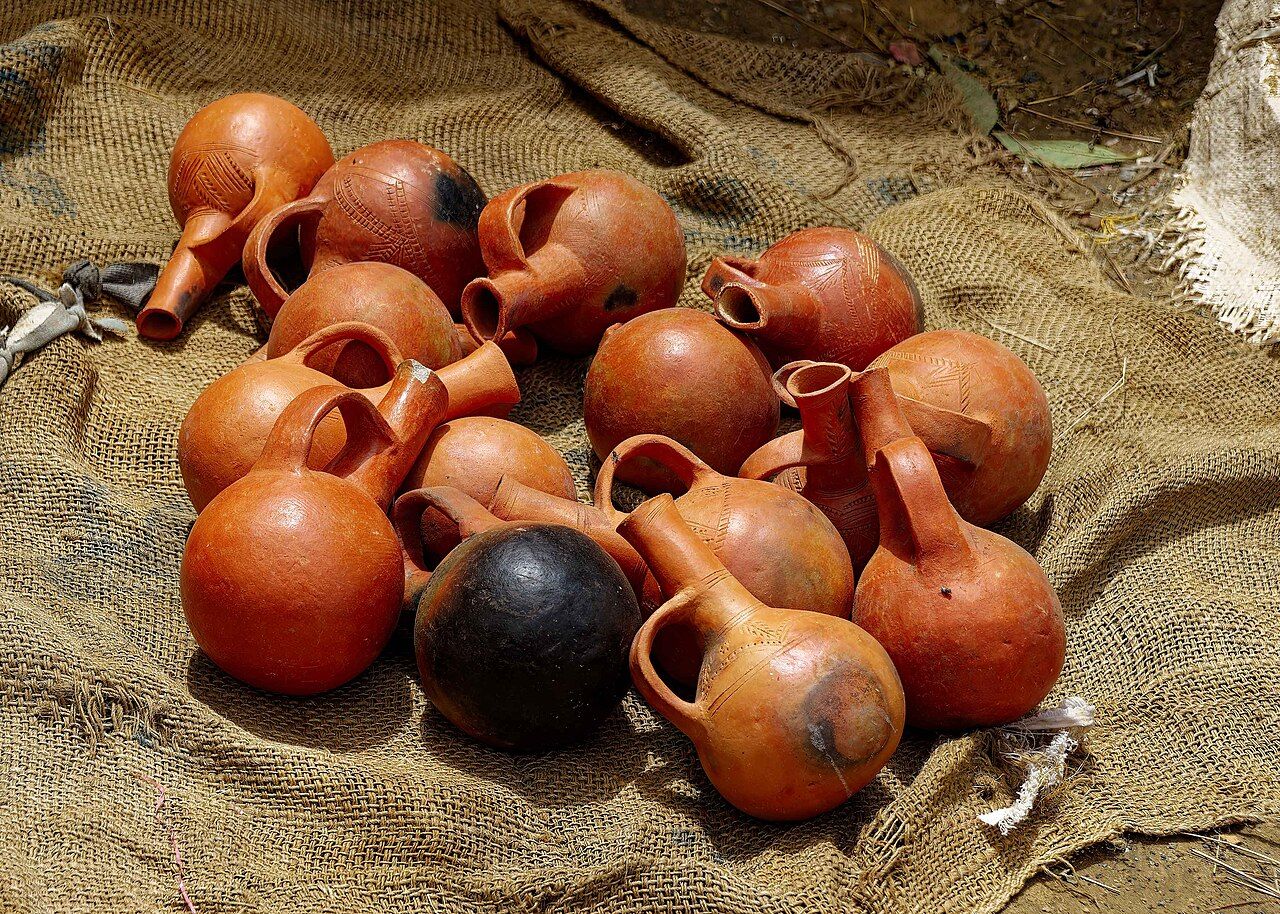
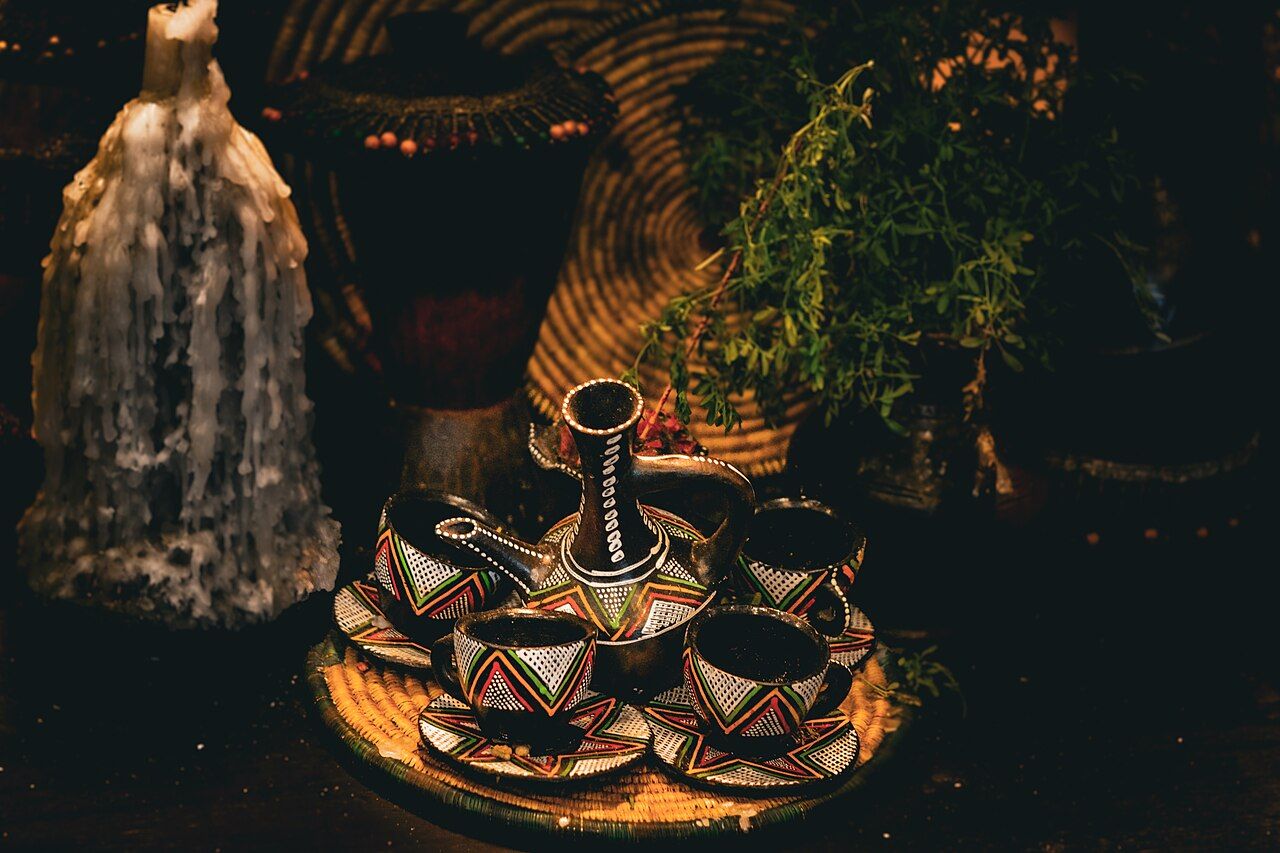
The roasted beans are ground by hand in a wooden mortar or a small grinder, and the grounds go into the jebena, a round clay pot with a long neck and spout. Water boils in the jebena on the coals, and the coffee is left to settle. It is then poured in a thin stream, from a height, into small handleless cups arranged on a tray, without stirring up the grounds. Snacks often come with it: popcorn, roasted barley or bread. Sugar is common, and in some places salt or butter is added instead. A sprig of rue is sometimes put into the cup.
Three rounds
A full ceremony has three rounds, each brewed from the same grounds with fresh water, so each cup is lighter than the one before. The first is called abol, the second tona and the third baraka, a word linked to blessing. Many people see the third round as the one that completes the ceremony, and leaving before it can come across as abrupt.
The three rounds also set the pace of a visit. Conversation, news and neighbourly business happen around the cups, which is the point. In homes, offices, markets and roadside stalls you will see the same ritual in simpler or grander forms, sometimes reduced to a single cup at a small stand by the road. Even a quick roadside cup is usually made fresh in a jebena, and the woman pouring it will often keep a pan of beans roasting for the next customer.
As a guest
If you are invited to a coffee ceremony, the main rule is to give it time. Plan for an hour or more, and do not start a ceremony you will have to leave halfway through. A few other points help:
- Accept the cup with your right hand or both hands.
- Compliment the aroma when the roasting pan comes round.
- Stay for at least two rounds, ideally all three.
- Ask before photographing the woman preparing the coffee or anyone present.
- If you cannot drink much coffee, take small sips; you can decline more politely.
Coffee also fits into the rhythm of the religious year. During festivals such as Timkat and Meskel, ceremonies follow each other through the day as families visit one another, and a single afternoon can bring several invitations.
Images on this page: Rod Waddington from Kergunyah, Australia (CC BY-SA 2.0); ProtoplasmaKid (CC BY-SA 4.0).

