PaceGive it two full days at least: one for each cluster with Bete Giyorgis at the end of the day, and a slow first morning while you adjust to the altitude. Other plates in this section.
Lalibela does not announce itself from a distance. You walk through an ordinary highland town of stone houses and eucalyptus, and then the ground opens: a roofline sits at your feet, and below it a whole church stands in a pit, carved from a single block of rock that was never moved. There are eleven of these churches, grouped in two clusters with one more set apart, and they remain places of worship rather than museums. Priests live and pray here, pilgrims sleep in the courtyards on feast days, and the chant rises from the trenches before dawn.
How the churches were made
Ethiopian tradition credits the churches to King Lalibela of the Zagwe dynasty, who ruled in the late twelfth and early thirteenth centuries and is said to have wanted a new Jerusalem in the highlands. The town, once called Roha, took his name. Historians debate how long the work took and whether some of the structures began as palaces or fortifications before they became churches, but the method is clear enough once you stand at the edge of a trench. Masons cut down into the soft volcanic tuff to free a block, then hollowed it from the outside in, leaving columns, arches, windows and roofs as part of the same stone.
Some churches are fully freestanding monoliths; others are joined to the rock on one or more sides, or are cut into a cliff face. Drainage channels, steps and narrow passages were cut at the same time, so the whole site works as one carved landscape. The local stream is called the Yordanos, the Jordan, and the hills and features around it carry names from the Holy Land. The site was among the first places in the world inscribed on the UNESCO World Heritage List, in 1978.
The northern cluster
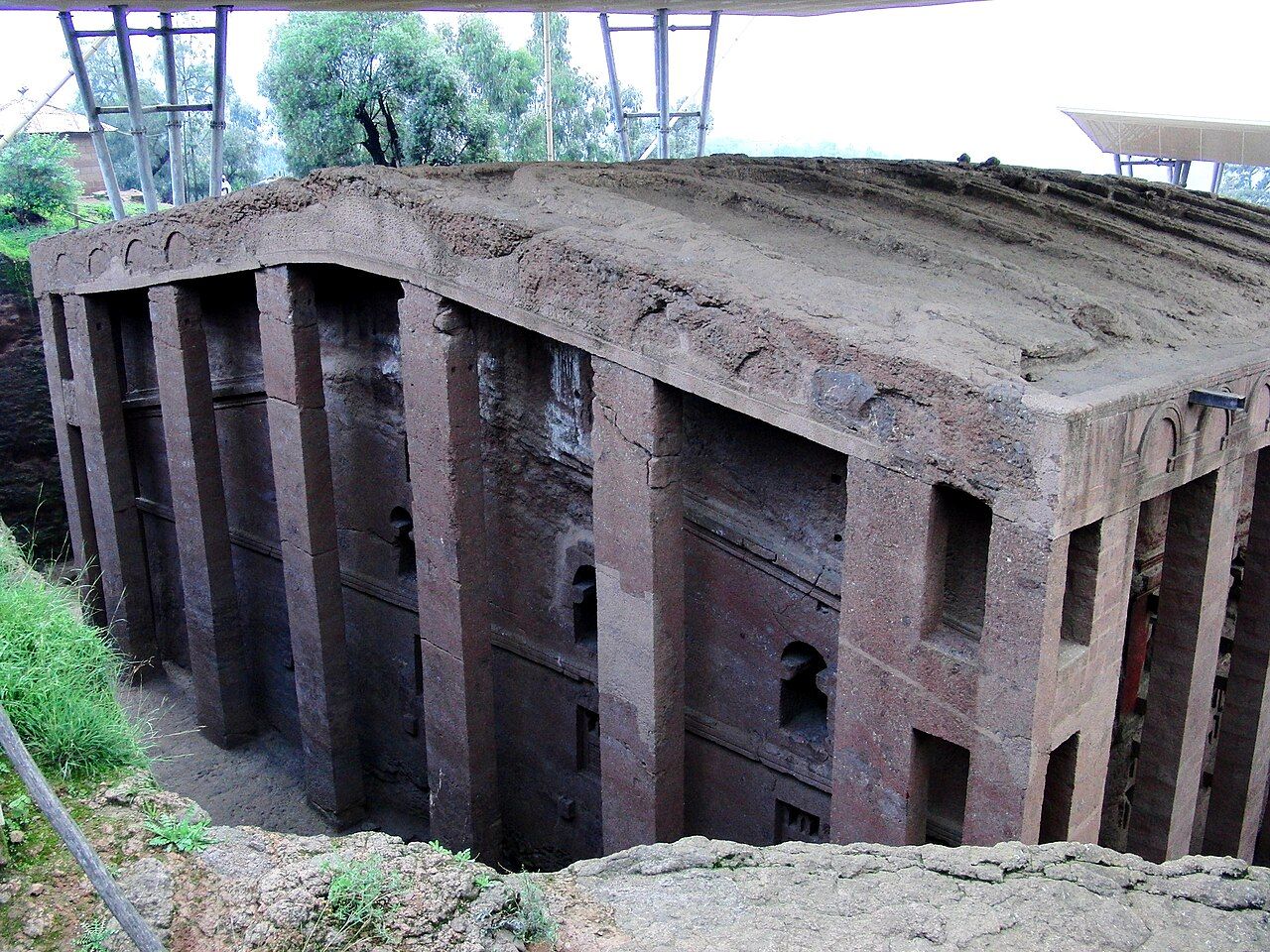
Most visits begin with the northern group. Bete Medhane Alem, the House of the Saviour of the World, is the largest of all the monolithic churches, a long rectangle ringed by square pillars, with a gloomy interior of five aisles. A processional cross kept here is one of the best known in the country. Next door, Bete Maryam is smaller and richer inside, with painted ceilings and carved crosses and stars, and it is the church most closely tied to the feast of Genna.
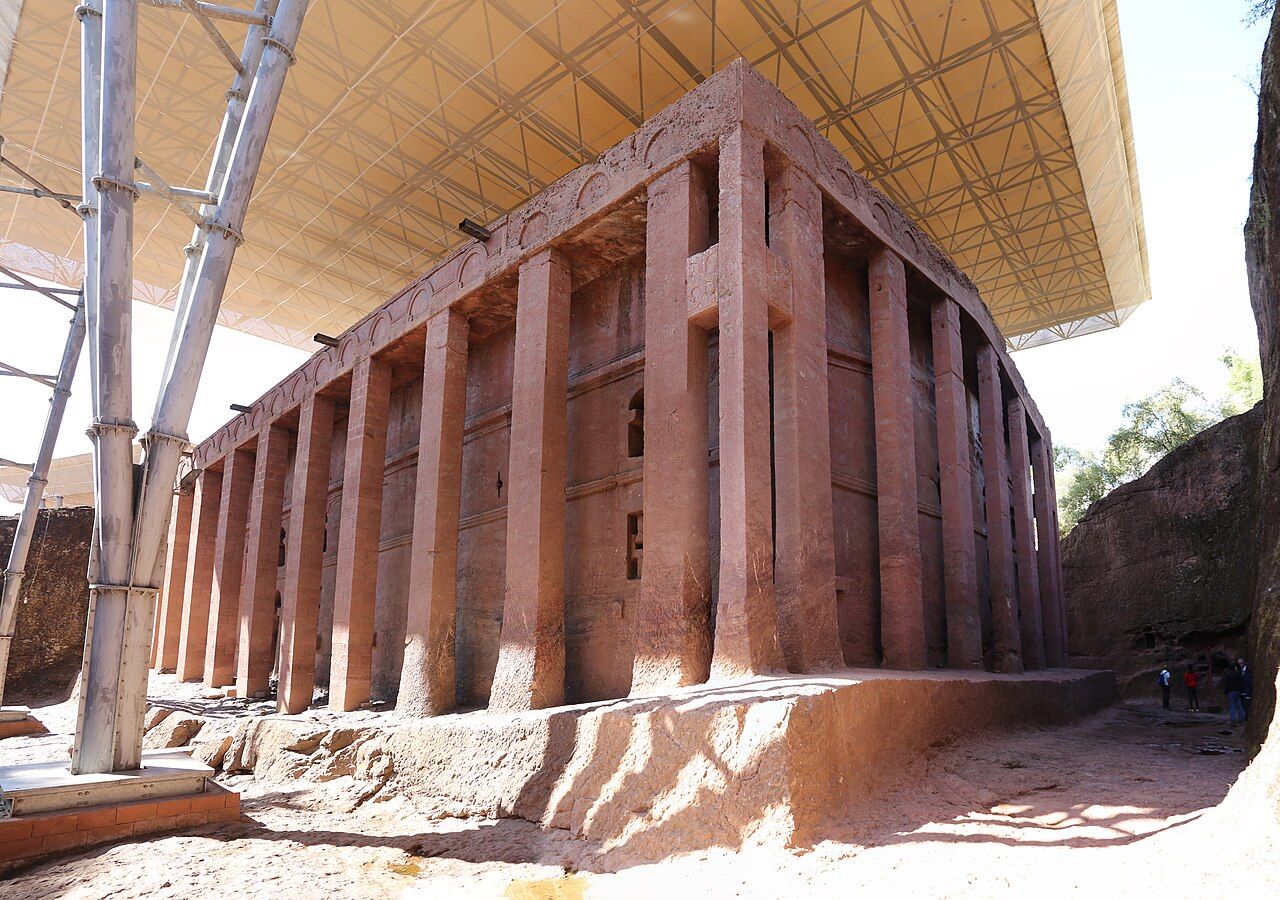
Around these two, narrow passages lead to Bete Meskel, cut into the wall of the courtyard, to Bete Denagel, the chapel of the virgins, and to the paired chapels of Bete Golgotha and Bete Mikael. Parts of this complex are closed to women; a guide or the priests will tell you which doors you may pass. Large modern shelters on steel legs stand over several of the churches to protect them from rain. They change the skyline, and they are there because water is the main threat to the rock.
Across the Jordan to the eastern cluster
The second group lies on the other side of the Yordanos and has a different character: more cliff-cut facades, deeper trenches and more scrambling. Bete Amanuel is the most finely finished, its exterior worked in imitation of the old Aksumite style of wood and stone layers. Bete Merkorios and Bete Gabriel-Rufael may have had a non-religious origin, and Gabriel-Rufael is reached by a narrow bridge across a deep moat. Bete Abba Libanos is carved into a cliff, attached to the rock above it, and Bete Lehem is a small shrine nearby.
The famous part of this cluster is the tunnel. A completely dark passage runs for some distance through the rock between two of the churches, and the tradition is that walking it in darkness is a lesson about the road from hell to heaven. You feel your way along the wall; a torch spoils the point, but carry one anyway for the other dim interiors. The cliff churches of Tigray and the painted halls of Gondar belong to the same faith, but nothing else in the country is built quite like this.
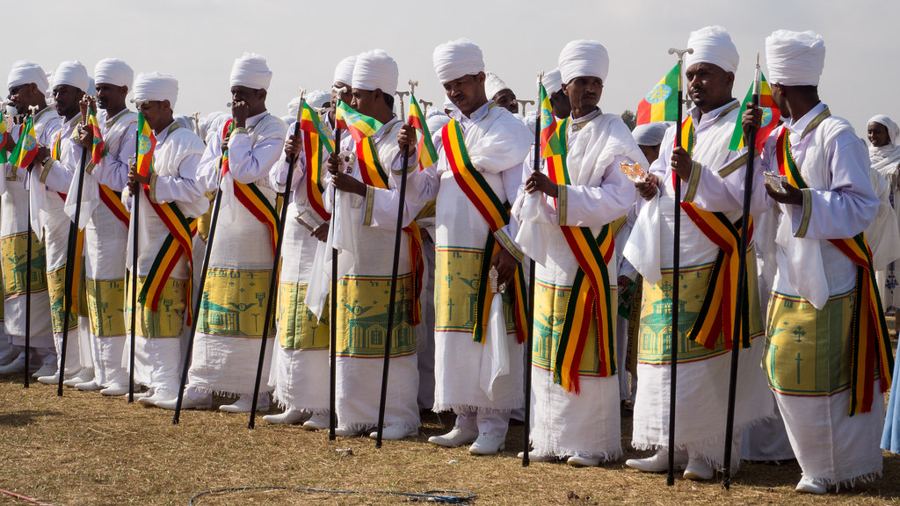 Plate 15 · EthiopiaTimkat, Meskel and Genna, the year's great feasts
Bete Giyorgis
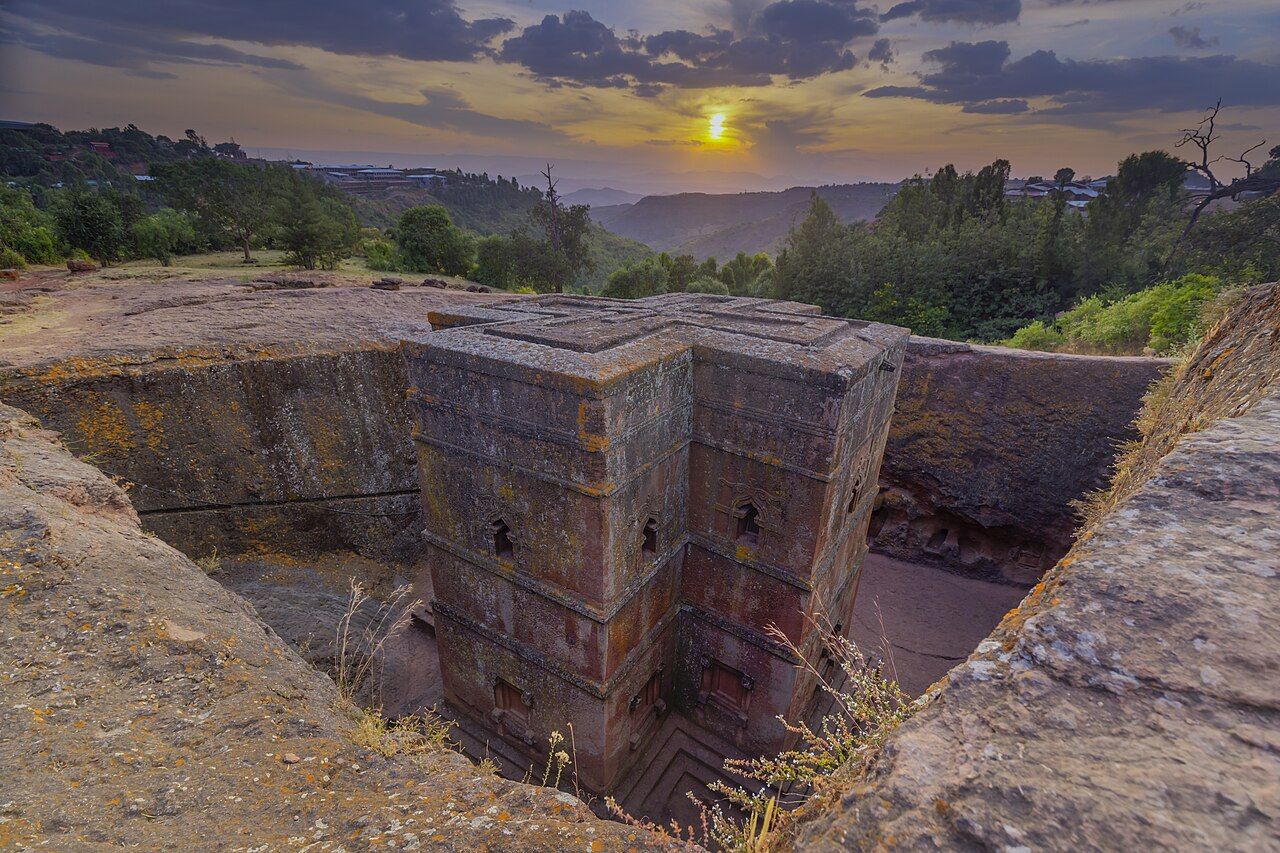
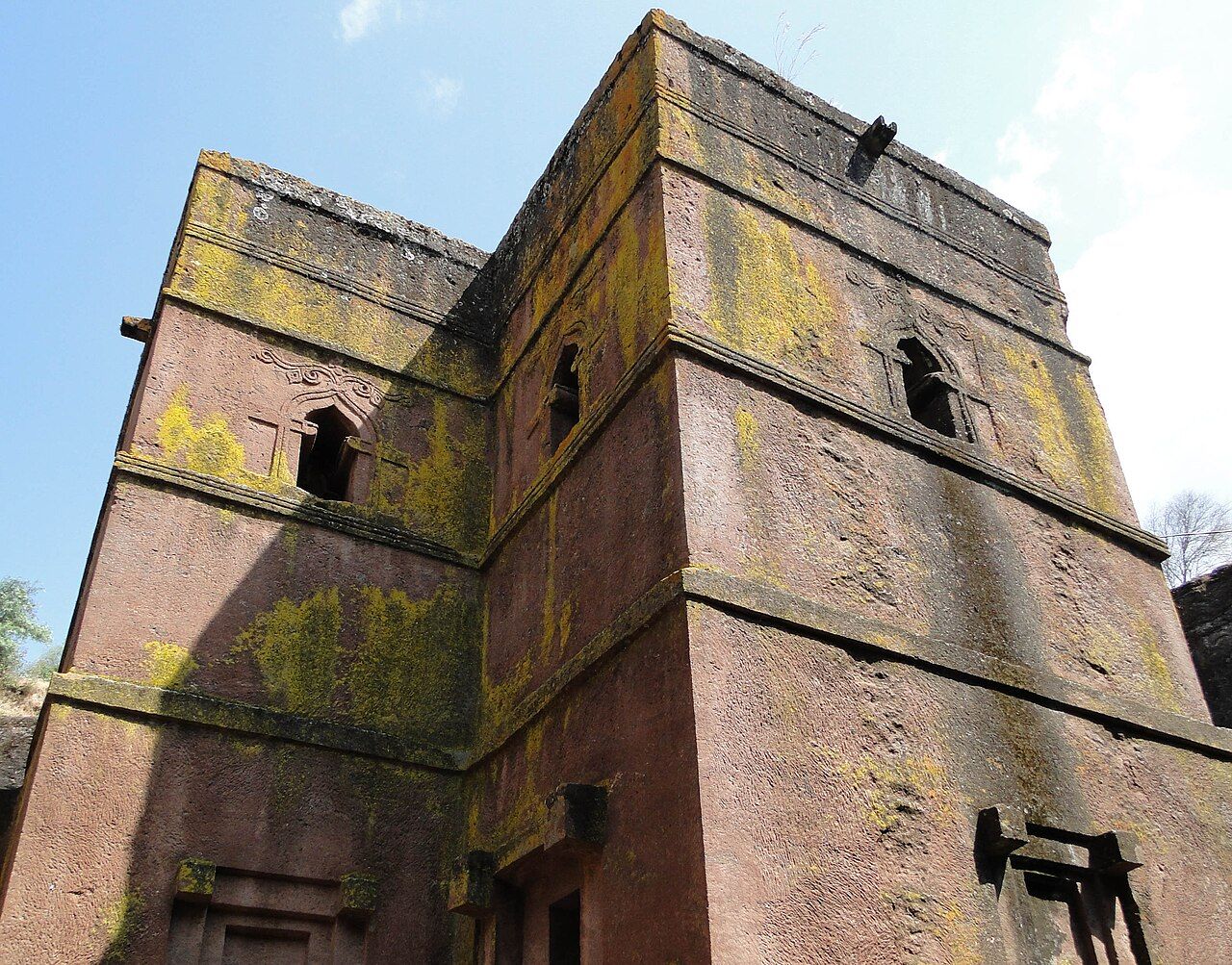
The church of Saint George stands alone, a short walk west of the clusters, and it is the image most people carry home. Seen from the rim, it is a cross in plan, cut down into a square pit about twelve metres deep, with a roof decorated by three nested crosses. Tradition says Saint George came to the king on horseback to ask why no church had been made for him, and the marks of his horse's hooves are pointed out in the rock.
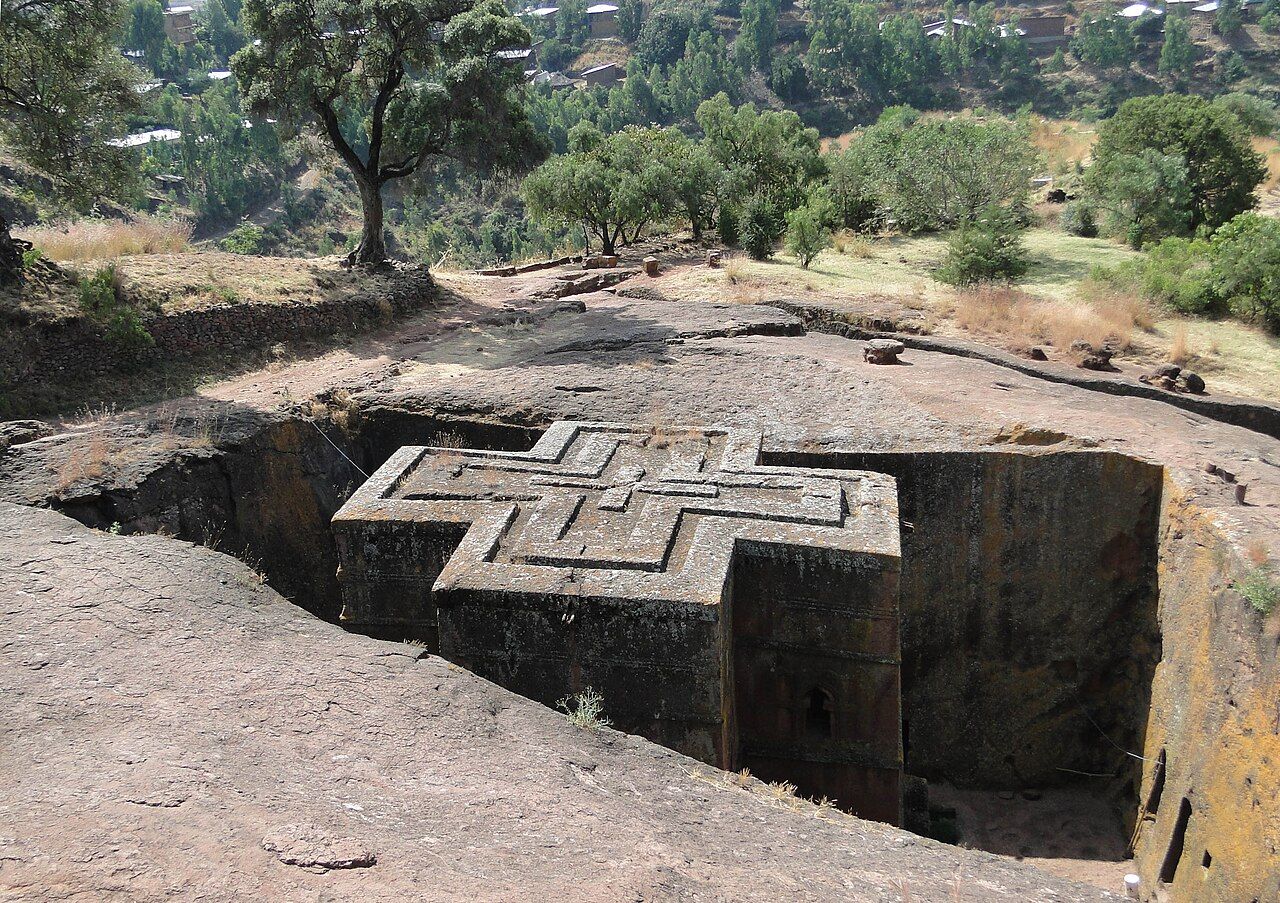
You reach the floor of the pit through a trench and a tunnel cut into the hillside, and at the bottom the scale changes completely: the walls of the church tower over you, and small caves in the sides of the pit hold the bones of pilgrims and monks.
Late afternoon is the time to see it, when the low sun turns the stone orange and the crowds have thinned.
Late afternoon is the time to see it, when the low sun turns the stone orange and the crowds have thinned.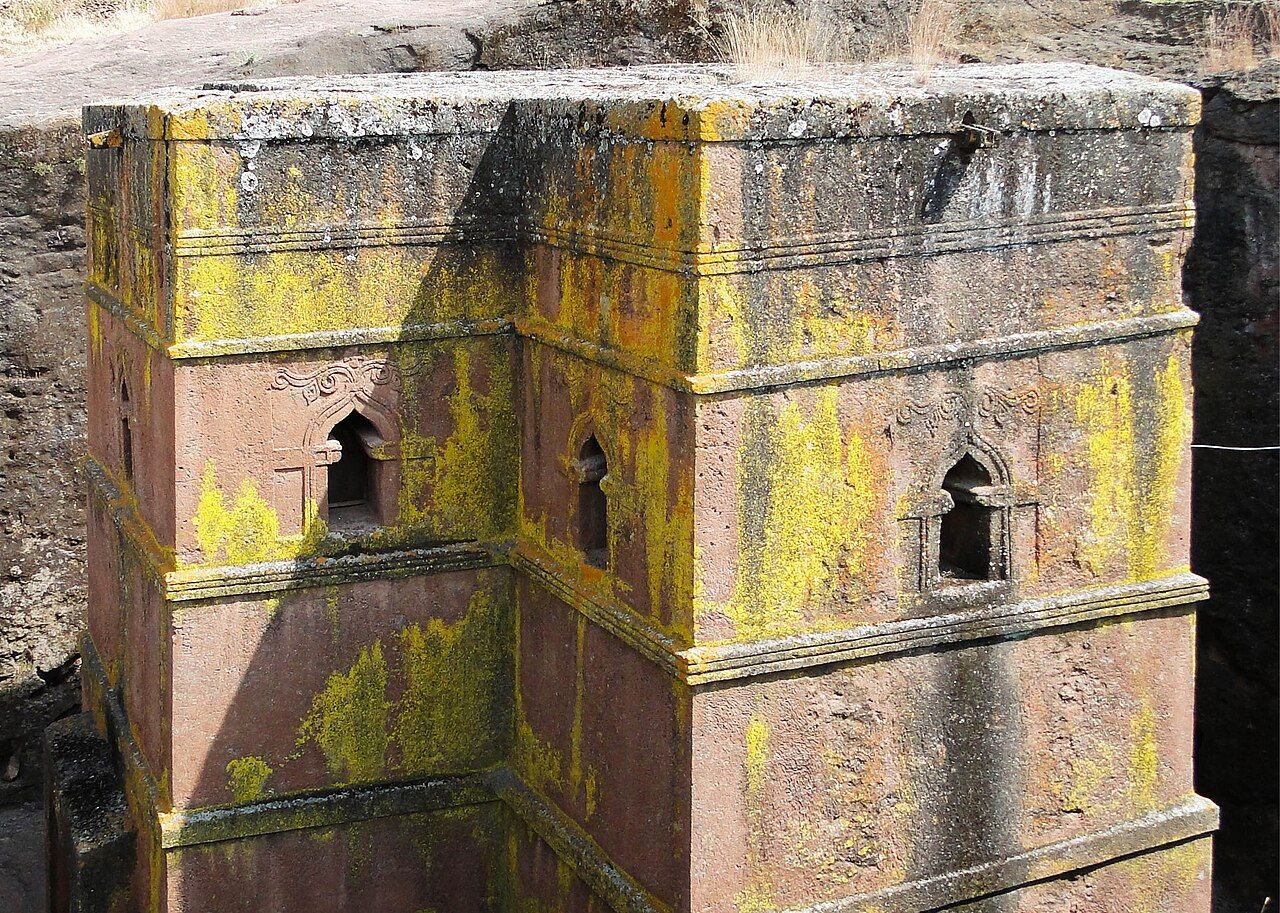
Priests, crosses and the feast days
In most churches a priest sits near the sanctuary and, when asked, brings out a hand or processional cross, sometimes an illuminated manuscript. Ask before photographing a priest, accept a refusal without fuss, and remember that a small offering to the church is customary. The inner sanctuary, where the tabot is kept, is closed to everyone but the clergy.
On ordinary days the site is quiet. At Genna, Ethiopian Christmas around 7 January, tens of thousands of pilgrims arrive, many on foot from far away, and the night service and the chanting of priests on the rim above Bete Maryam are one of the great sights of the Christian year. At Timkat, around 19 January, the tabots are carried out in procession to water and back. Both festivals fill every bed in town, raise the prices of everything and make the trenches very crowded. If you go then, arrange your room long in advance and accept that you will see the churches as a guest among worshippers, not as a sightseer.
Shoes, tickets and a guide
Shoes come off at every church door, so wear easy footwear and thick socks; the floors are covered with old carpets and the fleas are real. Dress modestly: covered shoulders and knees for everyone, and a scarf for women is appreciated. There are steep steps, uneven ledges and dark passages everywhere, and in the rainy season the stone is slick.
Entry works on a single site ticket for the churches, and in recent years it has been valid for several days, which suits the slow approach. A licensed local guide is worth having for at least the first visit: the layout is confusing, the history is mostly carried orally, and a guide smooths the way with the priests. Keep the ticket with you, because it is checked at different points.
Lalibela sits at about 2,500 metres, so take the first day gently. Domestic flights reach the airport outside town, and the road from the other northern towns is long and winding. Many travellers pair it with Gondar and Lake Tana on a loop through the north, and planning the circuit covers how those pieces join. The northern highlands have seen conflict in recent years.
Images on this page: Thomas Fuhrmann (CC BY-SA 4.0); Jens Klinzing (CC BY-SA 3.0); Sailko (CC BY 3.0); Bernard Gagnon (CC BY-SA 3.0); Bernard Gagnon (CC BY-SA 3.0); Bernard Gagnon (PD); jeanotr (CC BY 2.0).


